
Agentic lifecycle marketing for subscriber retention
Tl;dr
- Agentic lifecycle marketing uses AI agents to analyze subscriber behavior, identify retention opportunities, coordinate experiments, and manage approved journeys across the customer lifecycle.
- For subscription businesses, agents can handle routine decisions involving audience selection, experiment monitoring, and automation, while commercial teams retain control over pricing, incentives, and subscription terms.
Subscription businesses often have churn prediction models, CRM automation, and dedicated analytics teams. Yet moving from identifying an at-risk audience to testing a retention journey can still involve manual segmentation, coordination between teams for setting up experiments, and lengthy reporting cycles.
Agentic lifecycle marketing has the potential to make this process more efficient. The important consideration is deciding which activities an agent can manage independently and what evidence it needs before recommending or executing the next action.
What is agentic lifecycle marketing?
Agentic lifecycle marketing applies AI agents to decisions across onboarding, engagement, conversion, renewal, retention, and reactivation. An AI agent works toward a defined objective using customer data, connected marketing systems, and permissions established by the business. Depending on its capabilities, it can identify audiences, select approved journeys, coordinate experiments, and evaluate results.
Consider a publisher whose subscribers gradually reduce their reading activity. Traditional automation might trigger an email after 14 days of inactivity. A predictive model could identify declining engagement earlier by analyzing reading frequency, content breadth, and subscription history. An agentic workflow could then determine whether those subscribers qualify for an approved retention experiment, coordinate their assignment, and monitor whether the journey improves paid retention.
The agent's role extends beyond executing predefined triggers because it can use new information to decide which permitted action to take next.
For subscription businesses, the opportunity lies in connecting audience identification, experimentation, measurement, and automation into a process that requires less manual coordination.
Retention decisions and AI agent guardrails
The level of authority an agent receives should reflect the consequences of its decisions. Identifying a subscriber audience or monitoring an A/B experiment generally carries less commercial risk than changing renewal prices or introducing discounts.
A practical decision framework gives the agent responsibility for repeatable activities while reserving commercially sensitive decisions for human approval.
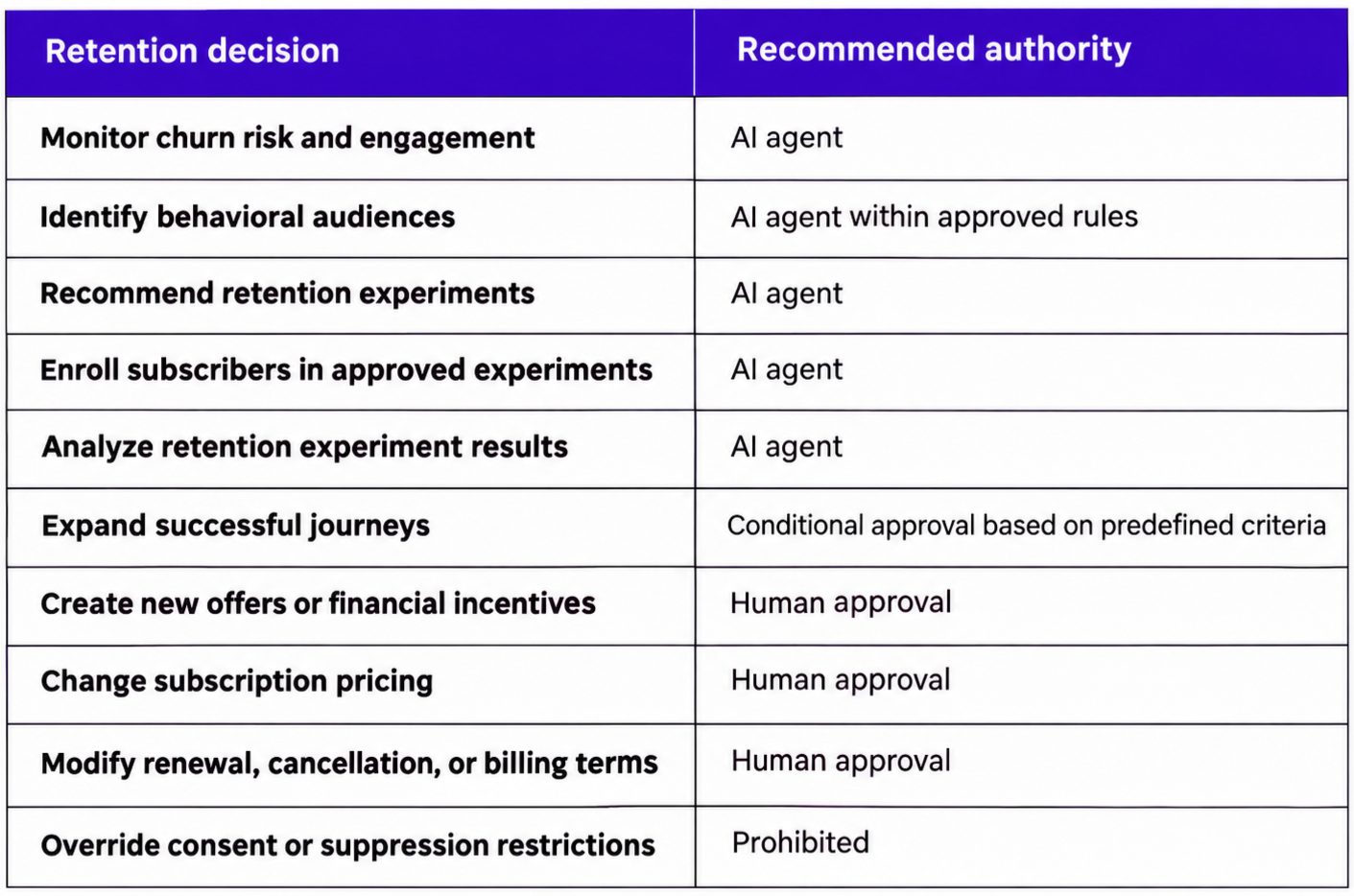
These recommendations describe how an agentic retention program should be governed. The actual authority available to an agent depends on the platform and its configuration.
Commercial decisions and permissions
An agent may identify subscribers whose engagement has declined and recommend an approved re-engagement journey. That decision can be evaluated through a controlled experiment. However, if the agent recommends offering those subscribers a substantial discount, the implications extend beyond retention.
Some customers receiving the discount may have renewed at full price. Others may remain subscribed only briefly, reducing the value of the additional renewals. A higher retention rate can therefore accompany a less attractive financial outcome.
Agents can analyze these trade-offs and recommend experiments, but commercial teams should approve changes to pricing, financial incentives, and customer terms.
How an AI agent should manage a retention experiment
Consider a subscription publisher trying to reduce cancellations among subscribers showing declining engagement. The business has approved a personalized content recommendation journey and wants to establish which audiences benefit from it.
- Identify the right subscriber audience
The agent monitors changes in reading frequency, content breadth, subscription tenure, and previous engagement. The AI agent identifies subscribers whose behavior matches the experiment's eligibility criteria and checks whether they are already receiving another campaign. This matters because declining engagement can mean different things across subscriber groups.
A customer who has rarely visited but renewed consistently for several years may be satisfied with occasional access. A new subscriber whose activity declines shortly after joining may be struggling to establish a reading habit.
The same journey may produce different results for these audiences, so eligibility rules need to account for their behavior and subscription history.
- Coordinate the approved experiment
Once eligible subscribers are identified, the agent can help coordinate the experiment through existing marketing systems. The experiment assigns subscribers to treatment and control groups. The treatment group receives personalized recommendations, while the control group continues receiving the defined baseline experience.
The agent should preserve experiment assignments and follow the agreed communication limits. If an appropriate journey hasn't been approved, the system can recommend a new experiment for the marketing team to review.
- Monitor retention outcomes
A personalized recommendation journey may increase visits or content consumption within days, while its effect on paid retention takes longer to establish.
The agent should monitor both engagement and subscription outcomes according to the experiment's measurement plan.
An increase in clicks or sessions may indicate that subscribers are responding to the recommendations. The retention team still needs evidence that the journey kept additional subscribers.
- Recommend the next action
Once the experiment reaches its planned measurement period, the results should be evaluated against the control group. If the journey demonstrates a reliable improvement and meets the business's rollout requirements, it may qualify for automation.
If the outcome remains uncertain, the experiment may need more observation. A negative result may justify stopping the journey or revisiting the audience.
The benefit of an agentic workflow is that audience management, experiment coordination, and monitoring can operate continuously within approved rules.
Importance of control groups in agentic lifecycle marketing
An agent can monitor thousands of subscribers and coordinate multiple experiments. That efficiency becomes a problem if it starts expanding journeys based on results that haven't been properly evaluated.
A randomized control group helps establish whether the journey generated an incremental improvement. Eligible subscribers are assigned to treatment and control groups, allowing the business to compare outcomes over the same period.
The difference in paid retention provides evidence of the journey's effect, subject to the quality of the experiment design and statistical uncertainty. For an agentic system, this establishes a useful operating principle.
An experiment should qualify for expansion based on its measured incremental impact and predefined success criteria.
Statistical reliability is important, although the decision also needs to account for financial costs, audience suitability, and customer experience. A journey that increases retention through expensive discounts may not generate sufficient additional revenue to justify its expansion.
A successful experiment can become an ongoing journey, but its original result doesn't guarantee the same performance indefinitely. Audience composition can change. Subscribers acquired through a new channel may behave differently, while pricing changes or product updates can alter the effect of an existing campaign.
Maintaining a control group during automation allows the business to continue evaluating the journey's incremental contribution.
Case study of retention experiments
DailyMail+ used Subsets to test personalized article recommendations across five subscriber audiences. Three audiences achieved statistically significant retention improvements compared with their respective control groups.
Subscribers showing declining usage recorded a 6.2-percentage-point retention lift, while those with declining content breadth achieved 4.9 percentage points. Subscribers whose reading time had declined recorded a 5.3-percentage-point lift.
The results demonstrated that personalization could improve paid retention for particular behavioral audiences. They also explain why agentic systems need audience-level evidence. A system recommending wider rollout should distinguish between the audiences where the journey demonstrated an improvement and those where its effectiveness remains uncertain. Expanding a journey based only on an overall campaign result can overlook those differences.
The same principle applies after automation. New subscribers should enter journeys under eligibility conditions supported by the original experiment, with continued monitoring to establish whether the results persist.
Retention metrics to monitor
An agentic lifecycle marketing system needs access to subscriber behavior and commercial outcomes. Churn risk helps identify audiences that may require attention, while engagement metrics show how subscribers respond to journeys. Paid retention and trial conversion establish whether the experiment improved the relevant subscription outcome.
For experiments with revenue implications, the agent should also monitor subscription revenue and customer lifetime value. These retention metrics help determine whether a journey generated additional commercial value.
Incremental retention lift is particularly important because it measures the difference between the treatment and control groups. The agent should also recognize when the available data is insufficient to support a decision.
What to look for in an agentic lifecycle marketing platform
Agentic AI marketing platforms differ in how independently they can operate. Some provide AI-generated recommendations for marketers to review. Others can coordinate approved activities across connected systems, while more autonomous products can make and execute decisions within configured permissions.
When evaluating a platform, subscription businesses should understand the operational capabilities behind those claims.
- Decision authority and approvals
An agentic marketing platform should allow businesses to define which decisions AI agents can make independently and which require human approval. This includes restricting automated actions to approved audiences, retention journeys, and offers, with guardrails that prevent unauthorized changes from being executed.
- Experimentation and measurement
Reliable experimentation requires the platform to maintain valid treatment and control groups, assess statistical significance, and measure incremental improvements in subscriber outcomes. These results should be connected to commercial metrics such as paid retention, conversion, revenue, and customer lifetime value, giving teams a clear understanding of each experiment's impact.
- Integration with existing systems
Agentic workflows rely on accurate subscriber data and seamless connections between the systems used for analysis and campaign execution. The platform should integrate with existing CRM, subscription, and analytics tools so teams can identify audiences, run experiments, and manage retention journeys without extensive manual coordination or additional engineering work.
- Monitoring and accountability
Marketing teams need visibility into how AI agents make decisions, including which audiences they select, which journeys they execute, and the evidence supporting those actions. The platform should also provide ongoing performance monitoring and allow teams to review, pause, or adjust automated journeys when results change or unexpected issues arise.
Subsets as an agentic lifecycle marketing platform
Subsets brings predictive audience discovery, controlled experimentation, retention measurement, and lifecycle automation together for consumer subscription businesses. Retention teams can identify relevant behavioral audiences, test journeys through existing communication platforms, and measure outcomes against control groups.
Successful experiments can become ongoing automations, with new subscribers entering journeys as they qualify and continued monitoring of retention, engagement, and lifetime value. These capabilities provide a foundation for agentic lifecycle marketing workflows that connect audience identification, experimentation, measurement, and automation.
For subscription businesses with established analytics and CRM teams, the opportunity is to reduce the manual coordination required to turn subscriber insights into measurable retention improvements. Request a demo to explore agentic lifecycle experimentation and retention automation with Subsets.
Frequently asked questions
How is agentic lifecycle marketing different from traditional automation?
Traditional automation executes predefined journeys and rules. Agentic lifecycle marketing introduces AI-driven decision-making, allowing systems to select and coordinate permitted actions based on customer behavior and business objectives.
What retention decisions can AI agents automate?
AI agents can monitor subscriber behavior, identify audiences, coordinate approved experiments, analyze results, and manage ongoing journeys within established rules. Their authority depends on the platform's capabilities and configured permissions.
Can AI agents monitor subscriber retention metrics?
Yes. AI agents can monitor churn risk, engagement, paid retention, trial conversion, subscription revenue, and lifetime value using connected data. They can also evaluate experiment outcomes against control groups and flag changes requiring review.