
AI retention for predicting churn, reducing cancellations, & proving what works
tl;dr
- AI retention uses artificial intelligence and machine learning to predict which subscribers are likely to cancel, identify the behaviors associated with churn, and help businesses test journeys that improve retention.
- For subscription businesses, this means using predictive audiences, controlled experiments, and automation to reach the right subscribers before they leave. By measuring results against control groups, retention teams can establish which journeys improve paid retention, revenue, and customer lifetime value, and scale the ones that work.
A subscription business can have a highly accurate churn prediction model and still struggle to reduce cancellations. It knows which subscribers are likely to leave, but deciding what to do with that information can require several teams, manual audience creation, and weeks of campaign planning.
Consumer subscription businesses often already have internal models for predicting churn, but many still struggle to identify specific behavioral audiences and determine which retention journeys will improve conversion and paid retention. Churn predictions provide a useful starting point, but teams also need to understand the behaviors driving cancellation risk, test relevant journeys, and measure their impact on subscriber retention. This is where AI retention becomes particularly valuable, helping teams connect predictive insights with experiments that produce measurable results.
What is AI retention?
AI retention uses artificial intelligence and machine learning to identify customer churn risks, analyze behavioral patterns, and improve decisions about how to retain customers. Depending on the technology, it can support churn prediction, behavioral segmentation, personalized retention journeys, controlled experimentation, and lifecycle automation.
For consumer subscription businesses, the objective is to improve paid retention and customer lifetime value by identifying opportunities to influence subscriber behavior before cancellation. AI models examine information from subscription history, product usage, billing, engagement, and CRM activity. These records can reveal patterns associated with churn, including changes that are difficult to detect through fixed audience rules.
For example, a news publisher might identify subscribers whose reading frequency has declined over several weeks. Similarly, a streaming service may find that trial users who haven't explored enough content are less likely to convert. Each example gives the retention team an audience to investigate and a starting point for developing experiments.
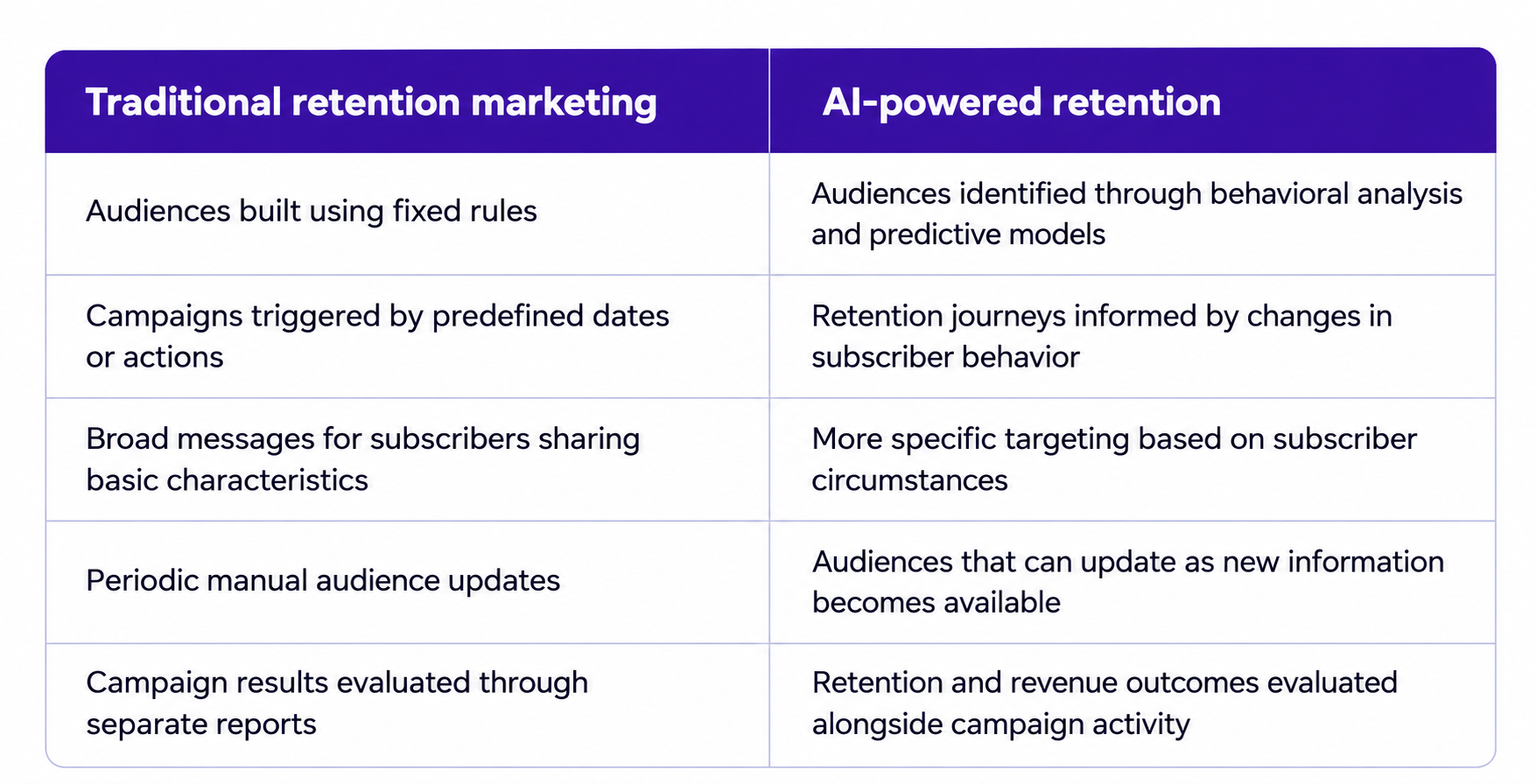
How AI retention differs from traditional retention marketing
Traditional retention campaigns generally rely on predefined triggers. AI makes it possible to consider several behavioral signals together. Two subscribers with identical periods of inactivity may have different cancellation risks because of their subscription history, previous usage, pricing, and engagement patterns.
Both approaches can operate together. A scheduled renewal reminder may work well as a rule-based campaign, while identifying subscribers who need additional attention before renewal may require predictive analysis.
How AI retention works
AI retention software can support several activities, although their importance depends on the capabilities a business already has.
- Predict which subscribers are likely to churn
Predictive models estimate the likelihood that a subscriber will cancel or fail to renew within a defined period. A model may identify subscribers at increased risk over the next 30 or 60 days using changes in usage, subscription tenure, billing, and engagement. For teams managing thousands or millions of subscriptions, this provides a way to prioritize attention without reviewing subscriber activity manually.
Prediction quality matters, but so does timing. A cancellation warning that arrives after the subscriber has already made their decision offers little opportunity to run a useful retention journey.
- Understand the behavior associated with churn
Subscribers can share a similar churn score for different reasons. One may have stopped using the product, while another remains active but is approaching a price increase. Behavioral analysis helps retention teams distinguish these circumstances and develop relevant experiments for each audience.
It also helps avoid sending unnecessary campaigns to subscribers who are likely to renew without additional contact.
- Test retention journeys against comparable subscribers
A churn prediction identifies risk, while an experiment establishes whether a proposed retention journey improves the outcome. For example, a publisher can identify subscribers whose reading frequency has declined and divide them randomly into two groups. One receives personalized article recommendations, while the control group continues receiving the usual communications.
Comparing paid retention between the groups helps the team establish whether the recommendations kept additional subscribers.
A large publishing business may already have analysts and experimentation capabilities. In that situation, the value of AI retention software may come from reducing the time spent preparing behavioral audiences, coordinating CRM execution, and analyzing results.
- Measure retention and revenue
Campaign engagement can indicate whether subscribers responded to a journey, but the commercial outcome depends on whether additional subscriptions were retained and how much value they generated.
Retention teams should measure results against the original objective, including paid retention, conversion, subscription revenue, or customer lifetime value. The same journey can produce different results across audiences. An overall campaign average may therefore conceal where the strategy was effective.
- Automate journeys that demonstrate an improvement
A successful experiment can become an ongoing journey for subscribers who meet the same behavioral conditions.
As new subscribers qualify, they can enter the journey through the existing CRM or communication platform. The business can continue monitoring results and retain a control group where appropriate to check whether the improvement persists.
This allows retention teams to expand successful experiments without manually rebuilding audiences and campaigns.
Prediction accuracy and experiment effectiveness are different measures
Consider two subscribers who both have a predicted 70% probability of cancelling. The first is approaching a price increase and has continued using the product regularly. The second has been inactive for months and has ignored several previous re-engagement campaigns.
Their predicted churn risks are identical, but a renewal reminder, personalized recommendation, or discount journey may have a different effect on each.
This creates three questions for the retention team.
- Who is likely to leave?
- Whose decision can be changed?
- Is the journey worth the cost?
The second question can be studied through controlled experiments and, where appropriate data are available, uplift modeling. Uplift modeling estimates how much a particular treatment changes an outcome compared with what would have happened without it. A conventional churn prediction model does not automatically provide that information.
A model with strong predictive accuracy can therefore be useful for identifying risk without establishing which retention experiment the team should run.
Choosing the right retention journey
Once an audience has been identified, the team needs to decide which retention journeys are worth testing. A generic discount may reduce cancellations, but it can also lower revenue from customers who would have stayed at full price. A personalized recommendation may improve engagement without changing renewals.
The journey should reflect the subscriber's circumstances and the commercial objective.
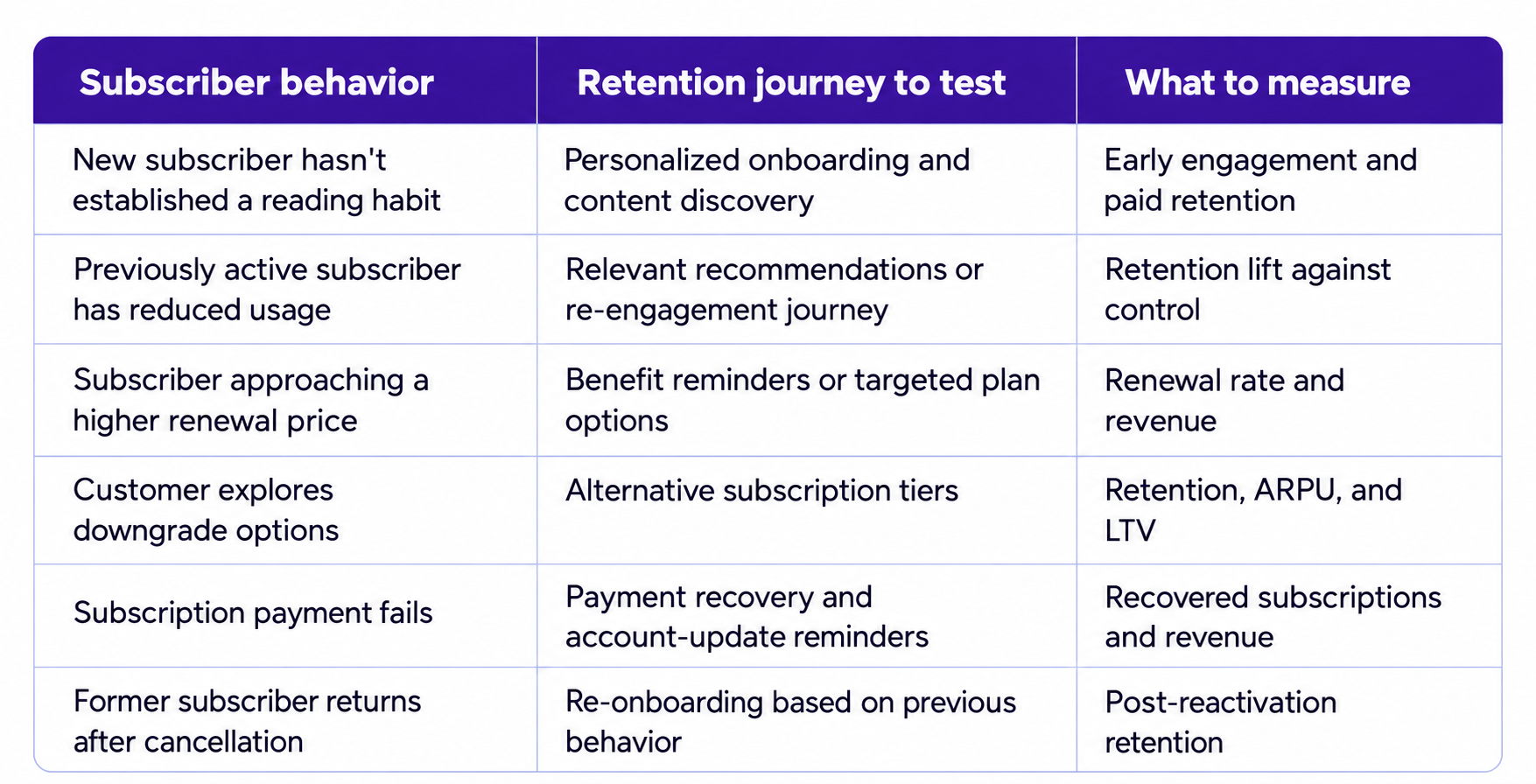
These are potential experiments rather than guaranteed solutions. Their effectiveness depends on the audience, and controlled testing helps establish which journeys are worth expanding.
Successful AI retention experiments
One publishing experiment tested personalized content recommendations across five subscriber audiences. Three audiences achieved statistically significant retention improvements, with the strongest recording a 6.2-percentage-point lift compared with its control group.
The results helped establish which audiences were responding to personalization and where the journey could be expanded.
A separate preference-survey experiment produced a useful counterexample. The journey improved outcomes among newer subscribers but recorded worse results among longer-tenured subscribers.
Even a well-designed campaign can produce different outcomes depending on who receives it. A retention team measuring only the overall campaign average may miss those differences and expand a journey to subscribers for whom it provides little benefit.
AI retention experiment’s success criteria
An AI retention program should be evaluated using the outcome it was intended to improve. For a churn-prevention experiment, the main measure may be paid retention after 60 days. For trial users, it may be conversion to a paid subscription.
Campaign engagement remains useful, particularly when it helps explain why a retention journey influenced subscriber behavior.
Metrics for measuring retention success
- Incremental retention lift: How much retention improved compared with a control group
- Trial conversion: How many eligible trial users became paying subscribers
- ARPU: Average revenue generated per subscriber
- LTV: Actualized or forecast subscriber value, including the effect of retention and pricing changes
- Revenue per subscriber: How subscription pricing or revenue differed between experiment groups
- Engagement: Whether a journey changed product or content usage, including sessions, visits, or content breadth
- Churn risk and predictive audiences: Which subscriber groups are at increased risk of cancellation and the behavioral patterns associated with that risk
DailyMail+ as a retention-lift example
DailyMail+ used Subsets to test a 40% subscription price increase among selected active subscribers. The retention team wanted to understand whether the additional subscription revenue would outweigh the cancellations caused by the higher price.
The experiment compared subscribers receiving the price increase with a control group that continued paying the original rate. Subsets tracked retention and revenue throughout the experiment and used those results to forecast customer lifetime value over different periods.
The published findings were as follows.
- +32% CLV lift per subscriber
- 40% higher ARPU on new price tier
- Minimal retention rate trade-off of 1.1% (better retention with the control group receiving no price increase)
The higher price produced some additional churn, but the revenue increase was large enough to improve forecast lifetime value per subscriber.
The 32% improvement is a three-year forecast based on observed retention and pricing data. It represents projected customer lifetime value rather than three years of realized revenue. Subsets updates the forecast as additional subscription data becomes available.
For DailyMail+, the experiment provided evidence to evaluate the pricing decision using both subscriber retention and long-term revenue.
The example also illustrates why a campaign with a higher save rate isn't necessarily the better commercial decision. Retention teams need to understand the relationship between how many subscribers stay, how much they pay, and what it costs to retain them.
What to look for in AI retention software
AI retention platforms vary in their primary capabilities. Some specialize in churn prediction. Others focus on personalized messaging, AI decisioning, subscription management, or experimentation.
A business should evaluate the technology according to the retention work it needs to accomplish.
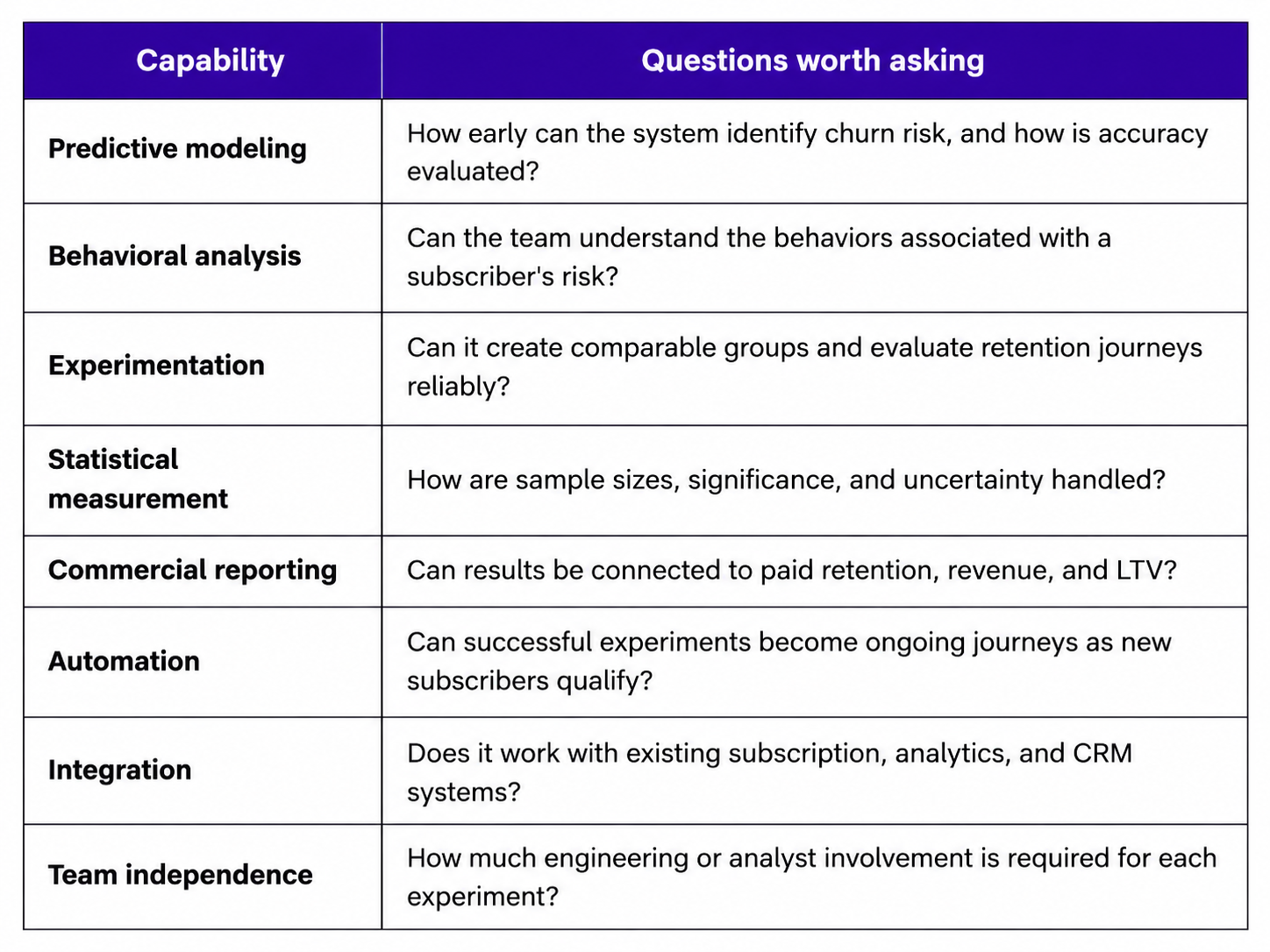
Statistical transparency deserves particular attention. A platform reporting an improvement should make it possible to understand how the comparison was constructed and what evidence supports the result.
For enterprise businesses with established analytics teams, this is especially important when deciding whether to introduce a new system into existing workflows.
How Subsets supports AI retention
Subsets is a comprehensive AI-powered retention platform built for consumer subscription businesses. It combines predictive audience discovery, behavioral analysis, controlled lifecycle experimentation, retention and LTV measurement, and automation in one platform.
Retention teams can identify subscribers showing signs of churn, understand the behavioral patterns associated with their risk, and test retention journeys through existing CRM and communication platforms.
Subsets measures results against control groups and helps teams turn successful experiments into ongoing automations. This supports retention across onboarding, engagement, renewal, reactivation, and win-back without requiring engineering or data science involvement for every experiment.
For businesses with established churn models and analytics teams, Subsets provides a more direct process for moving from subscriber analysis to experiment execution, measurement, and automation. Request a demo to see how Subsets supports AI-powered retention.
Frequently asked questions
What is AI retention?
AI retention uses artificial intelligence and machine learning to identify customers at risk of leaving and improve decisions about how to retain them. It can support churn prediction, behavioral analysis, personalized retention journeys, controlled experiments, and lifecycle automation.
How does AI improve customer retention?
AI can identify changes in customer behavior associated with cancellation and help businesses target relevant audiences earlier. Controlled experiments can then establish whether the selected journeys improve retention compared with what would have happened without them.
Is churn prediction accuracy enough to evaluate an AI retention platform?
Prediction accuracy is useful, but it doesn't establish whether the business can change a customer's decision. Teams should also evaluate how predictions are used, whether retention experiments improve outcomes, and the additional value generated by successful journeys.
What is the difference between AI churn prediction and AI retention?
Churn prediction estimates which customers are likely to leave within a specified period. AI retention covers the wider process of identifying risks, testing retention journeys, evaluating their effectiveness, and automating successful experiments.
Can AI identify which customers will respond to a retention offer?
With suitable experimental data, uplift models can estimate how different customers may respond to a retention journey. Standard churn models do not automatically provide those estimates, so businesses need to evaluate experiment effectiveness separately.
How do you measure the ROI of AI retention?
Compare the additional retention or revenue generated by an experiment with the costs of delivering the journey. Control groups help establish the incremental effect, while revenue and lifetime value measures help assess whether the result is commercially worthwhile.