
How to test churn prevention strategies

You can have encouraging engagement numbers from a churn prevention campaign, however they can have little to no effect on retention. A cohort of subscribers might respond to a personalized recommendation or promotional offer and still cancel at the next renewal, while the same treatment may produce different results across audiences. Retention and growth teams require a reliable way to establish which experiments reduce churn and where they work best.
Testing churn prevention strategies involves defining the audience, developing a hypothesis, running a controlled experiment, and measuring its impact over an appropriate period. The results should provide enough evidence to decide whether the experiment deserves further investment, needs adjustment, or should be discontinued.
Testable hypothesis
A churn prevention experiment should address a specific subscriber behavior that the team believes it can influence. The experiment would need the following:
- Audience: Paid subscribers whose engagement has declined over a defined period.
- Hypothesis: Personalized recommendations will improve retention among subscribers with declining usage.
- Treatment: A content recommendation journey tailored to reading preferences.
- Control: Eligible subscribers who continue receiving the existing experience.
- Primary metric: Paid subscriber retention over 60 days.
- Supporting metrics: Visit frequency, content breadth, and newsletter engagement.
- Success criteria: A meaningful retention improvement supported by sufficient statistical evidence.
Defining these conditions before launch keeps the experiment focused and makes the results easier to interpret. It also prevents engagement improvements from being mistaken for retention gains when the treatment has had little effect on renewal behavior.
For example, a publisher notices that paid subscribers whose reading frequency has declined over the past 30 days are more likely to cancel. The team tests whether a personalized email journey, featuring articles based on previous reading preferences, can improve retention compared with a control group receiving the usual communications. The primary metric here would be a paid subscriber retention after 60 days, while supporting metrics include visit frequency, content breadth, and newsletter engagement. The experiment is considered successful if retention improves against the control group and the result meets the predefined threshold for statistical significance.
Cohort based testing
A retention strategy that works for one subscriber audience may perform differently for another, even when both groups appear to have similar churn risks. Previous engagement, subscription tenure, and the circumstances behind declining usage can all influence how subscribers respond to an experiment.
The Independent's experiment with Subsets provides an example. The publisher tested a six-part email personalization journey designed to collect content preferences and improve newsletter recommendations, using separate treatment and control groups across different audiences.
The results varied:
- Audience A: A 3.9-percentage-point retention lift and 44% higher newsletter clicks.
- Audience B: An observed retention difference of -6.1 percentage points
The second result required further monitoring before the team could establish whether the treatment was helping or harming retention. Evaluating each audience separately allowed The Independent to see where personalization appeared effective without letting the stronger result obscure the uncertainty elsewhere.
Comparable groups
Subscribers in the treatment and control groups should meet the same eligibility criteria and be assigned randomly. Both groups need to be observed over the same period so that differences in renewal timing, seasonality, or acquisition history do not distort the result.
Existing lifecycle campaigns also need consideration. If subscribers receive a churn prevention treatment alongside a separate discount or renewal campaign, the team may struggle to establish which experiment influenced their behavior.
Before launching, confirm that:
- Audience eligibility and exclusions are clearly defined.
- Treatment and control groups are assigned consistently.
- Concurrent campaigns will not interfere with measurement.
- The sample size is sufficient for the expected retention lift.
- The measurement period covers the relevant renewal window.
These conditions help ensure that the experiment produces results the team can use when making decisions about future campaigns.
Metrics to measure
Engagement can provide an early indication that subscribers are responding, although the impact on retention may take longer to establish..
Matas used Subsets to test personalized re-engagement among dormant Club Matas Plus members who had previously been active. The experiment produced a 29-percentage-point lift in 30-day retention compared with its control group, alongside 39% higher web engagement and 20% more orders.
The combination of retention and commercial results helped demonstrate the value of the treatment beyond the immediate campaign response. Churn prevention experiments should report the following metrics where relevant:
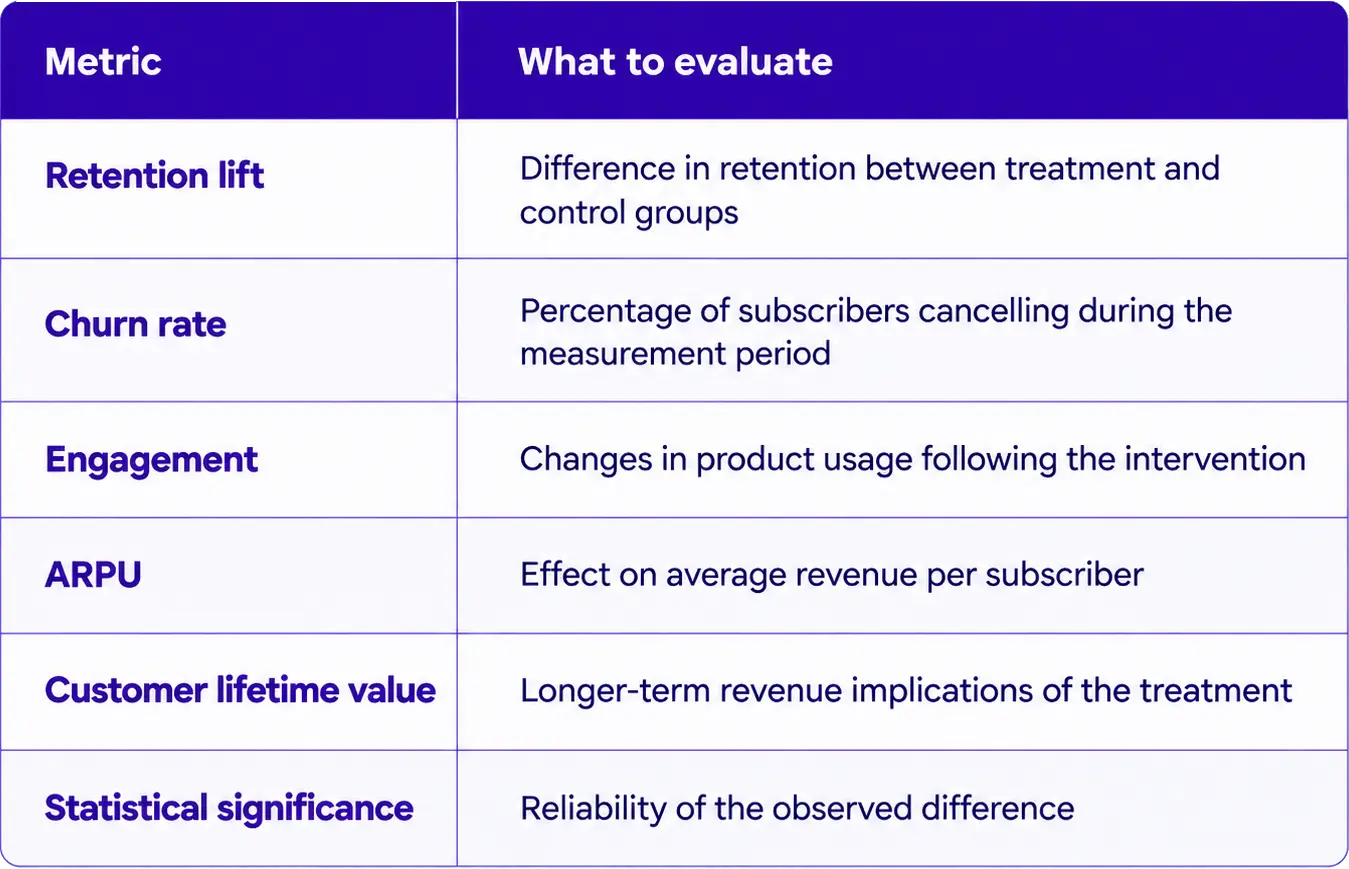
The primary metric should reflect the experiment's objective, while supporting metrics help explain the result. For treatments involving discounts or pricing changes, revenue measurement is especially important because an improvement in retention may come with a reduction in revenue per subscriber.
Experiments results as guideline
Retention teams should establish their decision criteria before the experiment begins and assess the results once the agreed measurement conditions have been met.
The outcome will generally fall into one of four categories:
- Positive retention lift: Expand the treatment to eligible subscribers once the result meets the agreed success criteria.
- Higher engagement without retention improvement: Investigate whether the engagement change has a delayed retention effect or whether another experiment is needed.
- Negative retention impact: Review the audience and treatment, and discontinue or revise the experiment if reliable evidence supports the decline.
- Inconclusive results: Reassess the sample size, measurement period, or hypothesis before deciding whether another test is worthwhile.
Some experiments also require observation across multiple renewal periods. A discount may prevent cancellation during the promotional window without improving retention after the subscriber returns to the standard price, making longer-term measurement necessary before the treatment is expanded.
Ongoing retention journeys
A successful experiment provides a tested treatment for a defined audience, which can then become part of the regular lifecycle program. The automation should preserve the conditions that made the experiment effective, including subscriber eligibility, timing of the experiment, and ongoing performance measurement.
A US-based streaming media company used Subsets to run 18 experiments across different subscriber lifecycle challenges. Its work included personalized onboarding journeys for high-risk trial audiences, producing a 10.1% improvement in trial subscriber retention.
With Subsets, teams can identify subscriber audiences, launch controlled experiments, measure their effect on retention and revenue, and automate treatments that demonstrate positive results. The platform provides the provision of maintaining control groups even as new subscribers enter the audience pool and also allows teams to assess whether the improvement continues over time.
Key takeaway
An effective churn prevention experiment should establish which subscribers benefit from a treatment, how much it improves retention, and whether the result is reliable enough to scale. The Independent's experience demonstrates the importance of evaluating audience-level results, particularly when the same experiment produces different outcomes.
Subsets helps retention teams test these experiments, measure their impact against control groups, and turn successful experiments into ongoing lifecycle journeys.
Book a demo to see how Subsets supports churn prevention experimentation and retention measurement.