.svg)

.svg)
Guide to AI-powered segmentation for subscribers
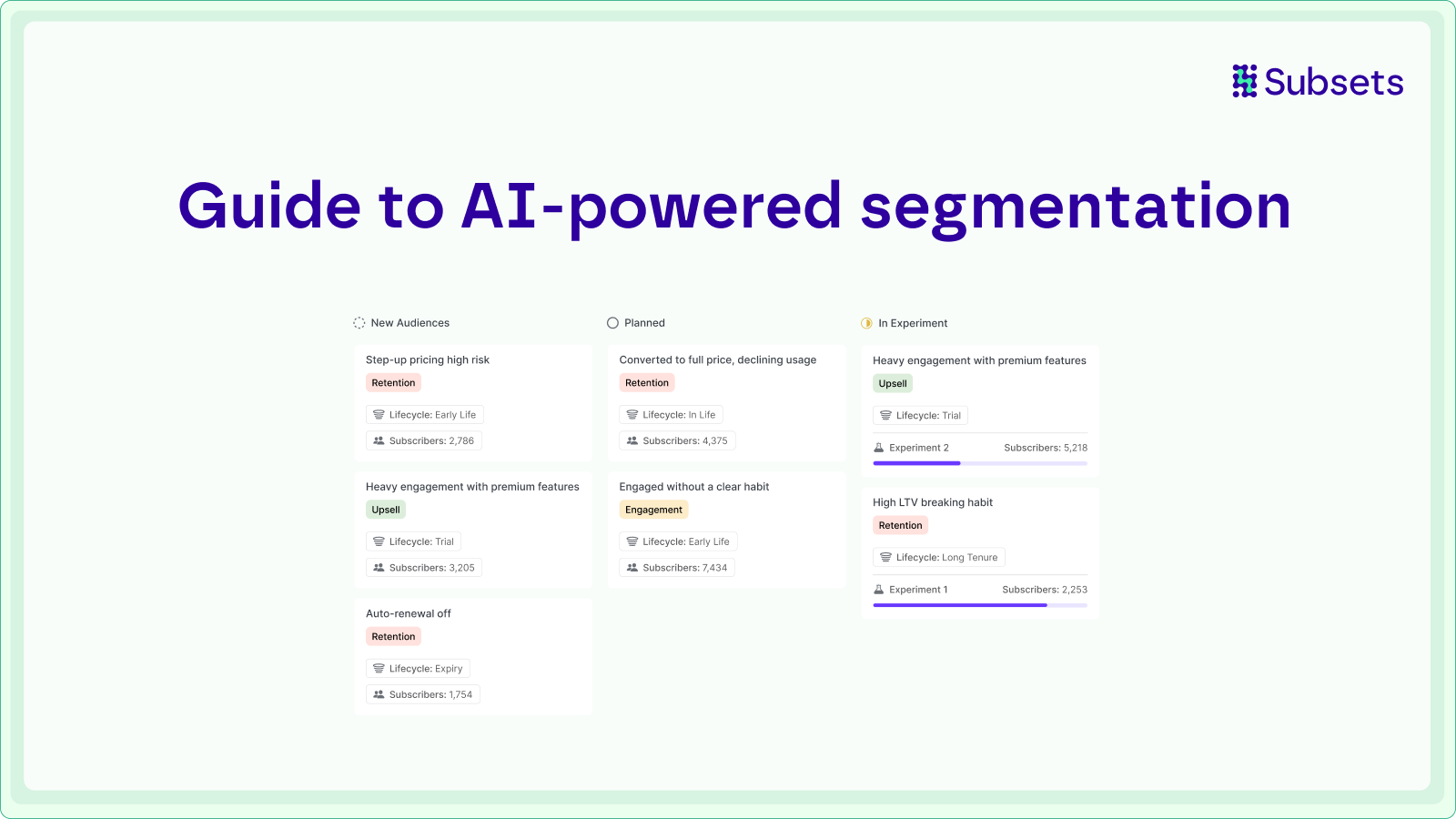
Segmentation in subscription businesses often begins with lists built around plan type, tenure, or recent activity. These structures help organize a subscriber base, but they provide limited guidance when it comes to deciding what action to take next.
The limitation becomes clear in execution, for example, two subscribers can fall into the same segment and still require entirely different interventions. One may be approaching an upgrade moment, while another may be moving toward churn. This kind of difference is not visible in static groupings.
What tends to matter more is how behavior changes over time. Patterns in usage, engagement, and billing often indicate where a subscriber is heading before outcomes such as churn or expansion become explicit.
AI-powered segmentation builds on this by grouping subscribers according to those patterns. The result is a set of audiences that map more directly to lifecycle decisions, making it easier to determine where to intervene and what to test.
Customer segmentation in a subscription context
Customer segmentation refers to the process of dividing a subscriber base into groups so that each group can be managed differently.
Traditional approaches rely on attributes such as plan type, subscription length, or acquisition channel. These attributes are useful for structuring communication and reporting, but they do not capture how subscribers behave after signing up.
Behavior-based segmentation focuses instead on how subscribers interact with the product. It looks at frequency of use, depth of engagement, and changes in usage patterns over time. This makes it possible to group subscribers based on how they are progressing through the lifecycle rather than where they started.
Limitations of rule-based segmentation
Rule-based segmentation is straightforward to implement and easy to maintain. It typically relies on conditions such as inactivity over a fixed period or time spent on a particular plan.
The challenge lies in how these rules are interpreted. Subscribers who meet the same condition may be moving in different directions. One may return to regular usage, while another may continue to disengage.
Static segments do not account for this variation. They capture a moment, but not the trajectory leading up to it. As a result, they provide limited guidance when deciding how to respond.
Segmentation becomes more effective when it reflects how behavior is evolving, not just what has already happened.
AI-powered segmentation evaluation signals
AI-powered segmentation brings together multiple data signals and evaluates how they interact over time.
In most subscription businesses, these signals include:
- Engagement data: How often a subscriber uses the product, which features they use, how deeply they engage per session, and whether that engagement is trending up or down over time.
- Billing behavior: Payment history, plan changes, whether they've ever paused or requested a refund, and how they responded to price changes.
- Acquisition context: How they found you, what offer they signed up on, and which channel brought them in. Subscribers acquired via a promotional discount often have a very different lifetime trajectory than those who signed up at full price.
- Support interactions: Whether they've contacted support, what they asked about, and how those interactions resolved. A subscriber who asked how to cancel three months ago is a very different risk profile from one who asked how to upgrade.
- Content or feature affinity: In media and SaaS subscriptions, especially, which specific content or features a subscriber gravitates toward tells you a great deal about where their value perception is anchored.
Each of these provides a partial view of subscriber behavior. The value comes from combining them.
Patterns begin to emerge when changes in usage are viewed alongside billing behavior or when engagement trends are considered in relation to acquisition source. These patterns make it possible to identify groups of subscribers who share similar trajectories, such as those gradually disengaging or those increasing their level of usage. Segmentation then shifts from describing subscribers to identifying where they are likely to move next.
Segmentation in practice
Segmentation becomes useful when it is directly connected to action. Each audience should correspond to a specific decision or intervention.
A practical structure follows a simple sequence:
- Define the segment
- Apply an action
- Measure the outcome
- Refine based on results
Over time, this creates a system in which segmentation informs ongoing lifecycle management rather than remaining a static classification.
Example 1: Declining engagement
A common and high-impact segment consists of subscribers whose usage is trending downward over time. This pattern typically appears before churn becomes visible in reporting.
These subscribers tend to visit less frequently, engage with fewer features or content, and show a gradual reduction in activity.
Learn how a streaming media company was able to boost engagement by +23% using Subsets
Actions for this segment focus on restoring engagement in a targeted way, for example:
- Re-engagement campaigns can be based on the subscriber’s past usage, guiding them back to familiar actions rather than introducing new ones.
- Product prompts can be triggered when usage drops, directing attention toward features that deliver clear value.
- Content or feature recommendations can also be tailored to previous behavior so that the next step feels relevant and easy to take.
Example 2: Trials not activated
Another important segment includes trial users who have not reached a meaningful activation point. These users have signed up but have not experienced the core value of the product. This is often reflected in limited engagement and incomplete onboarding.
Actions here focus on extending the window for value realization. These can include:
- Extending the trial period for low-engagement users provides more time to reach activation before a payment decision is required.
- Onboarding flows can be adjusted to emphasize one clear outcome, reducing complexity and guiding users toward the most important actions.
- Guided product experiences can also help users complete key steps without relying on self-directed exploration.
Example 3: Interest lost mid-lifecycle
Some subscribers remain active in billing while gradually reducing their level of engagement. This segment is often overlooked because revenue continues, even as usage declines. These subscribers show fewer sessions, reduced depth of interaction, and lower usage of key features over time.
Actions for this group focus on reinforcing value before disengagement deepens, which can include:
- Feature highlights can reintroduce parts of the product that have not yet been explored.
- Personalized recommendations can align with past behavior to maintain relevance.
- Lifecycle messaging can also be timed to periods of declining engagement, encouraging a return to meaningful usage.
Example 4: Highly engaged subscribers
Segmentation also identifies subscribers who are strong candidates for expansion. These users engage consistently, use core features deeply, and often show signs of approaching the limits of their current plan.
Actions for this group are centered on growth, such as:
- Upgrade prompts can be introduced at moments when usage indicates readiness, ensuring that the timing aligns with perceived value.
- Premium features can be surfaced within the product experience, allowing subscribers to see their benefits before making a decision.
- Pricing experiments can also be applied to understand which upgrade paths lead to sustained engagement after conversion.
Example 5: At risk of cancelling/churn
Another key segment includes subscribers who show early signs of cancellation risk. These signals may include declining engagement, billing-related friction, or changes in renewal behavior.
Actions in this case focus on maintaining the relationship, which can include:
- Downgrade options can be introduced to allow subscribers to continue at a lower level of commitment.
- Targeted retention offers can be aligned with how the subscriber has used the product rather than applied broadly.
- Prompts to update payment details or restore renewal settings can also address friction before it leads to a failed renewal.
Where to start & common mistakes
Starting with a single segment, typically one with clear retention impact, allows teams to define a specific action and measure its effect. From there, additional segments and interventions can be introduced gradually. Segments should update continuously as subscriber behavior changes, ensuring that actions remain relevant over time.
A focused approach is more effective than attempting to build a complete system at once.
Several patterns tend to reduce the effectiveness of segmentation. Segmentation performs best when it reflects real-life usage patterns and is maintained as an ongoing process.
- Treating surface-level activity as a measure of value can lead to misleading conclusions.
- Creating too many segments early on can make execution difficult without improving outcomes.
- Leaving segments unchanged over time reduces their relevance as subscriber behavior evolves.
- Acting on segments without understanding the underlying behavior can also limit the effectiveness of interventions.
Conclusion
AI-powered segmentation allows subscription teams to work with how subscribers actually behave across the lifecycle. When segmentation is connected to action, testing, and measurement, it becomes part of a continuous system that improves over time. Audiences evolve as behavior changes, and interventions become more precise through iteration.
Platforms such as Subsets support this approach by enabling teams to create behavioral audiences, run lifecycle experiments, measure their impact on retention and lifetime value, and automate what proves effective.
If you are looking to move beyond static segmentation and build a system that adapts to subscriber behavior, book a demo with Subsets to see how it works in practice.
Frequently asked questions
What is AI-powered customer segmentation for subscription businesses?
AI-powered customer segmentation for subscription businesses is the process of using machine learning to automatically group subscribers based on behavioral data, such as engagement patterns, billing history, and feature usage, rather than static attributes like plan type or signup date. Unlike traditional rule-based segmentation, AI segments update dynamically in real time and can predict future subscriber behavior, such as churn risk or upgrade likelihood, before it happens.
How does AI segmentation reduce churn in subscription businesses?
AI segmentation reduces churn by identifying at-risk subscribers before they cancel. By analyzing behavioral signals such as declining login frequency, shorter sessions, skipped content, etc. AI can flag subscribers who are disengaging weeks before they make a cancellation decision. This gives subscription teams a window to intervene with targeted retention campaigns, save offers, or personalized outreach while there is still time to change the outcome.
What data do you need to start AI customer segmentation for subscriptions?
The core data inputs for AI customer segmentation in subscriptions are engagement data (logins, feature usage, session depth), billing behavior (payment history, plan changes, refund requests), acquisition context (channel, offer type, signup price), and support interactions. You don't need all of these to get started as most teams can begin with engagement and billing data alone, but the more behavioral signals available, the more accurate and actionable the segments become.
.png)