.svg)

.svg)
Lifecycle automation strategies for subscription growth in 2026
Subscription growth in 2026 is different from what it was two years ago, as acquisition is no longer the primary constraint. Most teams can drive traffic, capture sign-ups, and launch offers at scale, especially with the help of AI-integrated tools. The challenge now sits deeper in the lifecycle of sustaining engagement, maintaining perceived value, and converting early interest into durable revenue.
Lifecycle automation has become the operating system that supports this shift. It functions as a coordinated system that continuously responds to subscriber behaviour, identifies points of friction, and interprets signals that indicate future value or risk.
This article explores how subscription businesses are approaching lifecycle automation in 2026, the strategies that actually move retention metrics, and how teams can build systems that improve over time rather than reset every quarter.
Why lifecycle automation now defines subscription growth
Most subscription businesses reach a point where acquisition efficiency plateaus. Traffic and spend increase, but retention remains flat. This is usually not a channel problem. It is a lifecycle problem.
Subscribers do not leave suddenly. They disengage gradually with usage softening, sessions shortening, and value perception weakening. By the time cancellation happens, the signals have been present for weeks or months.
Lifecycle automation exists to act inside that window.
Instead of treating onboarding, engagement, and retention as disconnected stages, automation connects them into a continuous system. Each subscriber interaction becomes an input that informs the next action or intervention. When done well, this approach replaces static journeys with responsive and adaptive experiences.
The result is a well-timed schedule of messages being sent out, with clearer relevance that results in measurable improvements in lifetime value.
The foundations of effective lifecycle automation
Before discussing tactics, it helps to understand what actually makes lifecycle automation work at scale.
Strong systems share three characteristics:
- They respond to behavior: Decisions are driven by usage patterns, engagement signals, and lifecycle state rather than demographic guesses or static rules.
- They learn over time: Experiments inform what works where winning paths become defaults, while poor performers are removed.
- They operate continuously: Automation cannot be treated as a one-time setup, as it evolves alongside changing user behavior.
Without these foundations, automation becomes noise rather than leverage.
Lifecycle automation strategies that drive growth
1. Designing automation around lifecycle stages
Subscription growth improves when automation aligns with how users naturally move through the product. Common lifecycle stages include:
- Awareness and early exploration
- Activation and initial value discovery
- Ongoing engagement and habit formation
- Renewal risk and value reinforcement
- Re-engagement after inactivity
Each stage requires different messaging, pacing, and success metrics. For example, early-stage automation should focus on helping users reach a first meaningful outcome, while later stages emphasize sustained value and relevance.
2. Use behavioral signals to guide timing and relevance
Lifecycle automation becomes effective when actions are triggered by behavior. Examples of meaningful signals include:
- Declining session frequency
- Reduced feature usage
- Interrupted onboarding flows
- Repeated engagement with a specific feature
- Billing or plan changes
These signals indicate intent before churn happens, so acting on them early allows teams to intervene while users are still receptive.
In practice, teams should ensure that automation is event-driven and that messages are triggered by the real-time behavior of the subscribers.
3. Build experimentation into the lifecycle itself
Automation without experimentation locks teams into assumptions. The most effective lifecycle systems treat every intervention as a testable hypothesis. Instead of asking, “Should we send this message?” teams ask, “Which version drives better retention for this audience?”
This approach includes:
- Control and treatment groups
- Clear success metrics tied to retention or revenue
- Time-bound evaluation windows
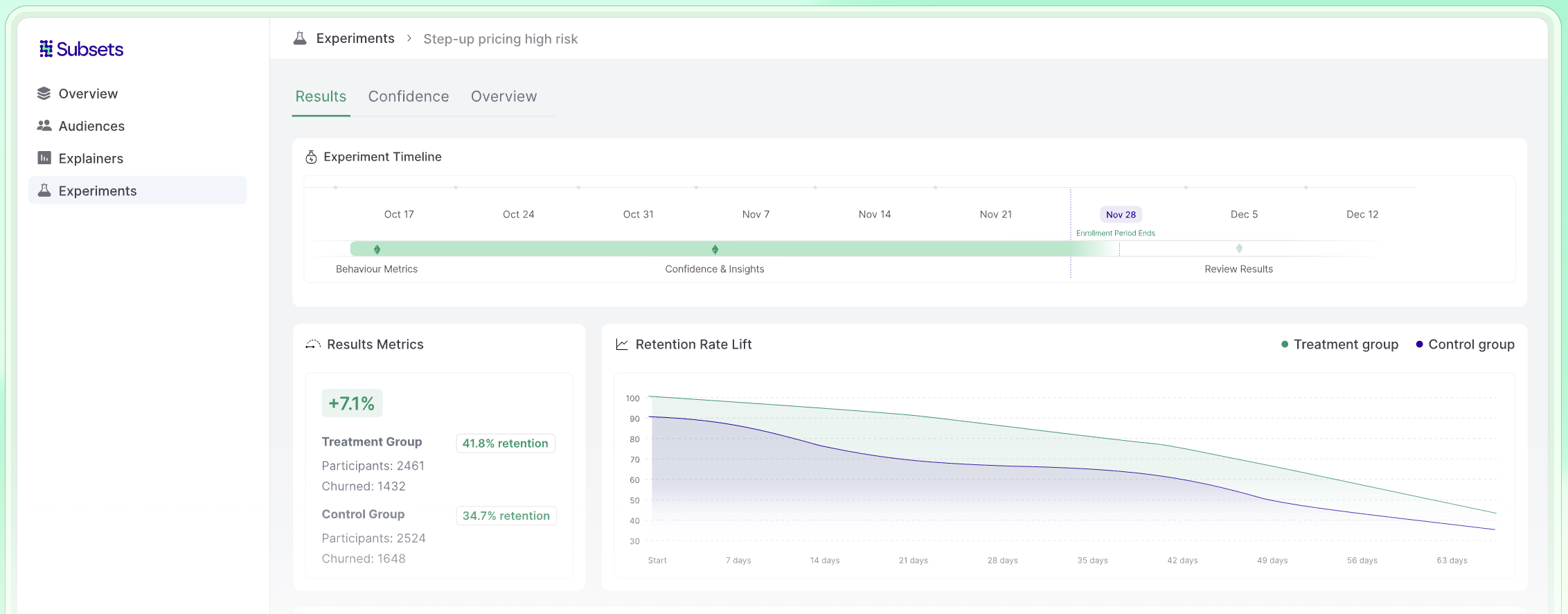
Over time, experiments compound into a knowledge base of what actually moves retention metrics. Automation then becomes a delivery mechanism for proven strategies rather than guesswork.
4. Focus on early activation as a growth lever
Activation remains one of the strongest predictors of long-term retention. Subscribers who reach value quickly are far more likely to stay.
Lifecycle automation helps teams:
- Identify which behaviors correlate with long-term engagement
- Guide users toward those actions during onboarding
- Adjust flows dynamically when early friction appears
Instead of a fixed welcome sequence, activation becomes adaptive. The system learns which actions matter most and steers users accordingly. This approach reduces time-to-value and improves downstream retention without increasing messaging volume.
5. Treat engagement decline as a signal
Engagement naturally fluctuates. What matters is how quickly teams respond when it starts to decline. Lifecycle automation allows teams to detect early drops in activity, segment users based on the type and depth of decline, or trigger tailored interventions before disengagement becomes permanent.
In practice, this could mean adjusting message cadence, highlighting relevant features, or temporarily reducing noise. The goal is to restore momentum without overwhelming the user.
6. Protect revenue with smarter save paths
Retention risk often surfaces before cancellation intent becomes explicit. Signals such as reduced usage, pricing sensitivity, or hesitation during renewal windows indicate that value perception is shifting.
Automation enables teams to test and deploy flexible pricing options, feature reminders aligned with usage history, or time-bound incentives that preserve margin.
When validated through experimentation, these interventions can significantly reduce revenue loss, with precision being key. Broad discounts erode value, while targeted save paths protect it.
7. Measure what actually drives growth
Lifecycle automation only works when measurement reflects real outcomes.
Strong programs track:
- Retention across multiple billing cycles
- Engagement depth
- Incremental revenue protected or recovered
- Long-term changes in customer lifetime value
This measurement discipline ensures teams focus on outcomes that matter to the business rather than surface-level engagement metrics.
Lifecycle automation in 2026
In 2026, subscription leaders are using automation to create systems that improve themselves over time. These systems share three qualities:
- Consistency: Proven interventions run automatically for every relevant subscriber.
- Adaptability: Journeys adjust as behavior changes.
- Accountability: Every action is tied to measurable impact.
This approach reduces dependency on manual execution and enables teams to scale without losing precision.
Closing thoughts
Lifecycle automation is the mechanism through which subscription businesses protect value, deepen engagement, and grow sustainably.
In 2026, the teams that win will not be the ones sending more messages. They will be the ones building systems that respond intelligently to behavior, learn continuously, and scale without friction.
Subsets supports lifecycle automation by connecting behavioral data, experimentation, and journey orchestration into a single operating system.
Teams use Subsets to:
- Identify predictive audiences based on real usage patterns
- Run controlled experiments across lifecycle stages
- Measure retention impact with statistical confidence
- Promote winning interventions into automated journeys
This allows commercial teams to operate with clarity and speed, without relying on engineering for every change. When lifecycle automation is designed with discipline and supported by experimentation, retention becomes predictable, and growth follows naturally. Book a demo with our team to learn how you can implement this for your business.
.png)