.svg)

.svg)
Subscription lifecycle management (SLM) and the role of retention in maximizing ROI

The subscription economy has fundamentally changed how businesses generate revenue. Effective subscription lifecycle management is the strategic approach that determines whether your subscription business thrives or struggles, directly impacting both retention and return on investment. Growth does not come from a single campaign or channel, but from how well a business manages the full arc of the subscriber lifecycle over time.
What is subscription lifecycle management (SLM)?
Subscription lifecycle management (SLM) is the systematic process of guiding customers through every stage of their relationship with your subscription service, from initial awareness to renewal and potential expansion. This comprehensive approach encompasses customer acquisition, onboarding, engagement, retention, expansion, and win-back strategies, all working together to maximize customer lifetime value and business ROI.
Unlike traditional customer relationship management, subscription lifecycle management addresses the unique challenges of recurring revenue models, where customer retention becomes exponentially more valuable than one-time transactions. Companies that excel at managing the subscription lifecycle can achieve retention rates above 90%, while those that neglect it often see churn rates exceeding 30% annually.
Critical stages of subscription lifecycle management
Understanding each stage of the subscription lifecycle allows businesses to implement targeted strategies that reduce churn and increase revenue at every customer touchpoint.
1. Acquisition stage
The journey begins when prospects discover your offering. During this stage, subscription lifecycle management focuses on attracting the right customers who are most likely to remain engaged long-term. Marketing qualified leads are nurtured through targeted content, free trials, and demonstrations that showcase value immediately.
Effective acquisition strategies consider customer acquisition cost in relation to predicted lifetime value, ensuring that marketing investments will generate positive ROI. Businesses should segment prospects based on their likelihood to convert and remain as long-term subscribers, rather than simply maximizing trial signups.
2. Onboarding and activation
The onboarding stage is where many subscription businesses either cement customer relationships or lose them. Research consistently shows that subscribers who experience value quickly during onboarding have significantly higher retention rates.
Subscription lifecycle management during this phase involves creating seamless activation experiences that help customers achieve their first success moment as rapidly as possible.
Best practices include:
- Personalized welcome sequences
- Guided product tours
- Educational resources tailored to user goals
- Proactive support during the critical first 30 days
Companies that reduce time-to-value during onboarding can improve retention by 25% or more.
3. Engagement and value delivery
Once activated, subscribers enter the ongoing engagement phase where consistent value delivery retains them. Subscription lifecycle management here means monitoring product usage patterns, identifying customers at risk of churning based on declining engagement, and implementing intervention strategies before cancellation occurs.
Engagement strategies include regular communication that highlights unused features, personalized recommendations based on usage data, and creating feedback loops that demonstrate you're listening to customer needs. For example, one of our customers achieved a 14% engagement lift from tenured subscribers with declining usage and 4.7% retention lift from re-engaging dormant subscribers.
4. Renewal and retention
The renewal stage represents a critical decision point where customers evaluate whether to continue their subscription. Effective subscription lifecycle management anticipates renewal periods and strengthens the value proposition before customers consider alternatives.
Retention strategies during this phase include:
- Demonstrating ROI through usage reports and analytics
- Offering renewal incentives for annual commitments
- Addressing pain points proactively
- Creating switching costs through integrations and customization.
Companies should track leading indicators of churn at this stage, such as decreased login frequency, and feature usage decline.
5. Expansion and upsell
Loyal subscribers present significant expansion opportunities that directly impact ROI without additional acquisition costs. Subscription lifecycle management identifies subscriber ready for upgrades based on usage patterns, business growth signals, and feature limitations they're encountering.
Successful expansion strategies include tiered pricing that creates natural upgrade paths, usage-based pricing, and add-on features that solve emerging needs.
6. Win-back and reactivation
Even with excellent retention efforts, some subscribers will still cancel their subscriptions. Advanced subscription lifecycle management includes win-back campaigns that re-engage former subscribers who may have left due to temporary circumstances rather than fundamental dissatisfaction.
Win-back strategies involve exit surveys to understand cancellation reasons, targeted offers addressing specific objections, pause options instead of full cancellation, and reactivation campaigns highlighting new features or improvements made since departure.
How subscription lifecycle management drives ROI
The financial impact of effective subscription lifecycle management extends far beyond simple retention metrics, fundamentally transforming business economics and profitability.
Reducing customer acquisition cost impact
While acquiring new subscribers is essential for growth, acquisition costs in subscription businesses can take 12-24 months to recoup. Subscription lifecycle management improves ROI by extending subscriber relationships well beyond the payback period, allowing each subscriber to generate significantly more revenue than the initial acquisition investment.
Example scenario:
- Acquisition cost: $200
- Monthly subscription value: $50
- Breakeven: Month 4
- 24-month retention: $1,200 revenue = 6x ROI
Increasing retention from 12 months to 24 months essentially doubles ROI without any additional acquisition spending.
Maximizing customer lifetime value
Customer Lifetime Value (LTV) represents the total revenue a business can expect from a single subscriber relationship. Subscription lifecycle management directly increases LTV through three mechanisms: extending subscription duration, increasing average revenue per user through upsells and cross-sells, and reducing service costs as users become more self-sufficient.
Businesses with mature lifecycle management programs often achieve CLV-to-CAC ratios of 5:1 or higher, compared to ratios of 2:1 or 3:1 for companies with basic retention efforts. This difference represents the competitive advantage that allows market leaders to outspend competitors on acquisitions while maintaining superior profitability.
Creating predictable revenue streams
One of the most valuable aspects of effective subscription lifecycle management is revenue predictability. When businesses can experience:
- Stable financial foundation for growth
- Revenue predictability for planning
- Higher valuations from investors
- Confidence in long-term strategic execution
High retention rates create compounding effects where recurring revenue accumulates month over month.
Reducing operational costs
Mature subscription lifecycle management reduces costs throughout the organization. Commercial teams become more efficient as they use data to prioritize interventions, support costs decrease as onboarding improves, and users become self-sufficient.
Companies report that the cost of retaining an existing subscriber is typically five to seven times lower than acquiring a new one. Our CEO, Martin Johnsen, mentions this in his subscriber retention masterclass with INMA. Watch now
As subscription lifecycle management matures, these efficiency gains compound, allowing businesses to scale revenue without proportionally scaling costs.
Essential components of effective subscription lifecycle management
Implementing world-class subscription lifecycle management requires the integration of several key components that work together to optimize subscriber relationships.
Data Infrastructure and analytics
Successful lifecycle management depends on data foundations that track user behavior, usage patterns, engagement metrics, and financial performance across all lifecycle stages. Modern subscription businesses need unified platforms that connect billing data, product analytics, support interactions, and marketing engagement in a single view.
Key metrics to track include:
- Monthly recurring revenue (MRR)
- Net revenue retention
- Customer acquisition cost (CAC)
- Lifetime value (LTV)
- Churn rate and reasons
- Time to value
- Product adoption rates
- Engagement scores
Without comprehensive data, lifecycle management becomes guesswork rather than strategic optimization.
Segmentation and personalization
Not all subscribers follow identical lifecycle journeys, which makes segmentation critical for effective management. Businesses should segment users by usage patterns and product adoption, company size or user demographics, acquisition channel and original campaign, subscription tier and revenue potential, and risk profile for churn.
Each segment requires tailored lifecycle strategies that address its specific needs, challenges, and opportunities. Personalization at scale, enabled by marketing automation and AI-driven recommendations, allows businesses to deliver relevant experiences without unsustainable manual effort.
Cross-functional alignment
Subscription lifecycle management cannot succeed as a siloed initiative. It requires coordination across marketing, sales, product development, customer success, support, and billing teams. Each function plays a role in specific lifecycle stages, and handoffs between teams must be seamless to avoid subscriber experience gaps.
Leading subscription companies create shared lifecycle metrics that align all teams around retention and expansion goals, implement regular cross-functional reviews of lifecycle performance, and establish clear ownership for each lifecycle stage while maintaining collaborative workflows.
Automation and technology stack
Manually managing customer lifecycles becomes impossible at scale. Successful programs leverage technology for triggered communications based on behavior and milestones, automated health scoring that identifies at-risk users, personalized content delivery across channels, subscription billing and revenue recognition, and predictive analytics that forecast churn and expansion opportunities.
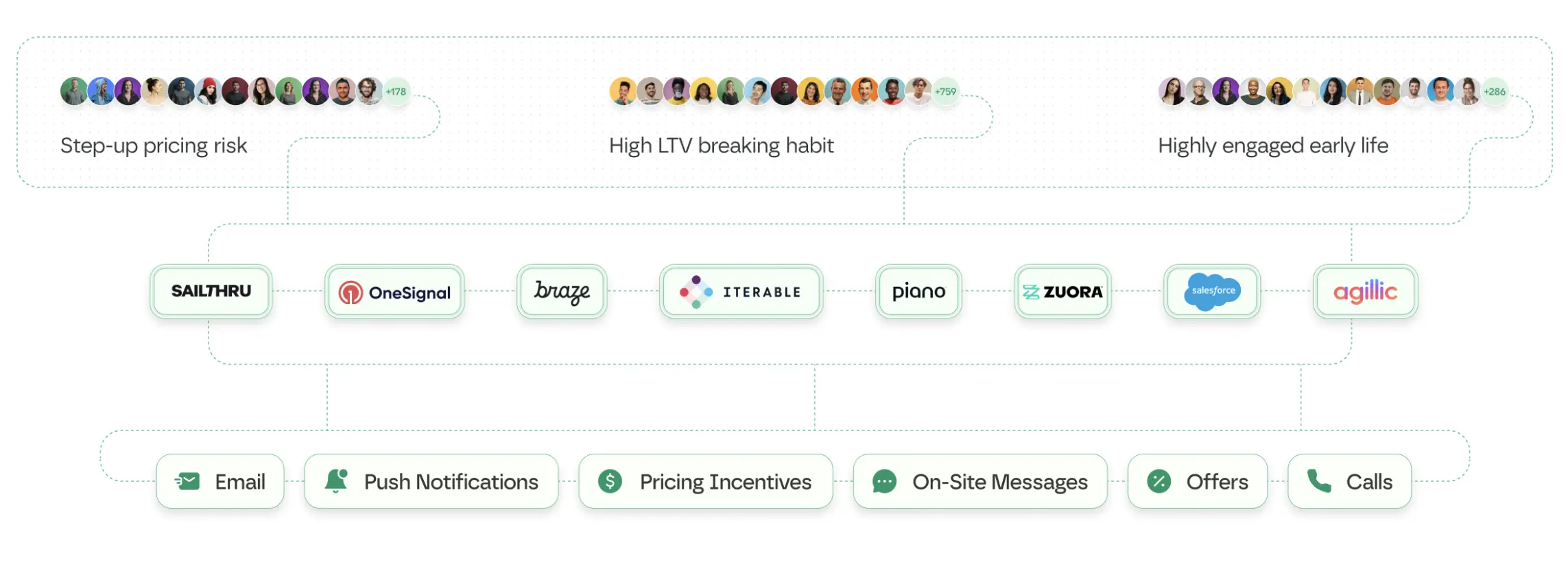
The right technology stack varies by business size and complexity, but typically includes a customer data platform or analytics tool, marketing automation system, customer success platform, billing and subscription management software, and product analytics tools.
Best practices for optimizing subscription retention
Retention sits at the heart of subscription lifecycle management, and specific practices have proven most effective at reducing churn and extending subscriber relationships.
Continuous value communication
Users often forget the value they receive from subscriptions over time, leading to cancellations when budgets tighten. Regular value communication combats this by sending usage reports highlighting accomplishments enabled by your service, sharing ROI calculations specific to each subscriber, providing benchmarks showing performance versus peers, and celebrating milestones and anniversaries.
These touchpoints reinforce the subscription's value proposition and create emotional connections that reduce price sensitivity during renewal decisions.
Flexible subscription options
Rigid subscription structures force users into all-or-nothing decisions. Offering flexibility reduces churn by allowing pause options for temporary non-use, downgrades to lower tiers rather than complete cancellation, add-on selections that customize value, and payment flexibility, including annual discounts or seasonal adjustments.
While flexibility introduces complexity, it prevents losing customers who might return to full subscriptions once circumstances change.
Strategic pricing and packaging
Pricing structure significantly impacts lifecycle economics. Best practices include creating clear value differentiation between tiers to encourage upgrades, establishing usage-based elements that align costs with value received, offering annual plans with meaningful discounts to lock in longer commitments, and regularly testing price changes with new customers to optimize acquisition and retention balance.
Pricing should be viewed as a lifecycle management tool rather than a static decision, with regular reviews ensuring it supports retention and expansion goals.
Measuring subscription lifecycle management success
What gets measured gets improved, making the right metrics essential for optimizing lifecycle performance and demonstrating ROI impact.
Core retention metrics
Net revenue retention measures revenue from existing customers, including upgrades, downgrades, and churn, with world-class SaaS companies achieving 110-130% annually. Subscriber retention rate tracks the percentage of users who remain subscribed over specific periods. Monthly recurring revenue growth shows the combined impact of new sales, expansion, and churn on predictable revenue.
These metrics provide the clearest picture of lifecycle management effectiveness and directly correlate with business valuation and strategic health.
Leading indicators
While retention metrics show results, leading indicators predict future performance and enable proactive intervention. Product engagement scores based on feature usage and login frequency signal customer health before churn occurs. Time to value measures how quickly new customers achieve their first success milestone. User health scores combine multiple factors into predictive risk assessments. Support ticket volume and sentiment often spike before cancellations.
Monitoring leading indicators allows teams to address issues during earlier lifecycle stages when intervention is most effective and least costly.
ROI calculation framework
To demonstrate the business impact of lifecycle management investments, companies should calculate CAC payback period showing how retention improvements accelerate ROI, CLV-to-CAC ratio improvements over time, revenue impact of reducing churn by specific percentages, cost savings from decreased acquisition dependency, and expansion revenue as a percentage of total growth.
These calculations justify continued investment in lifecycle programs and help prioritize initiatives based on potential impact.
Conclusion
Subscription lifecycle management represents the difference between businesses that merely survive in the subscription economy and those that dominate their markets. By systematically optimizing each stage of the subscriber lifecycle journey, companies transform economics from treadmill dynamics to compounding growth machines.
The question is not whether to invest in subscription lifecycle management, but how quickly you can implement comprehensive programs that turn retention into your most powerful growth engine and ROI multiplier. Companies that answer this question decisively will lead their industries, while those that delay will find themselves perpetually struggling to replace churned customers rather than building on an expanding base of loyal advocates.

.png)