.svg)

.svg)
Customer winback strategies for subscription businesses
Churn does not always mark the end of the subscriber relationship. For subscription businesses willing to act with precision, speed, and genuine empathy, the moment of cancellation is often the beginning of a second, and far stronger, relationship.
Why focus on winback?
Acquisition is the most competitive, expensive, and fragile aspect of gaining new subscribers. Yet most subscription businesses still allocate the lion's share of their marketing budget toward filling the top of the funnel rather than recovering the customers who already believe in their product.
Subscriber acquisition costs have increased while conversion rates have declined across businesses. This has shifted the economics of growth.
That's a costly mistake because a churned subscriber is not a stranger. They know the product, they have experienced the value, and they made a considered decision which means they can make a new one. When the winback campaign lands at the right moment with the right message, the company is renewing a relationship.
The value of winback comes from:
- faster conversion cycles
- higher familiarity with the product
- stronger long-term retention when reactivated
This makes winback a practical extension of retention rather than a separate growth channel.
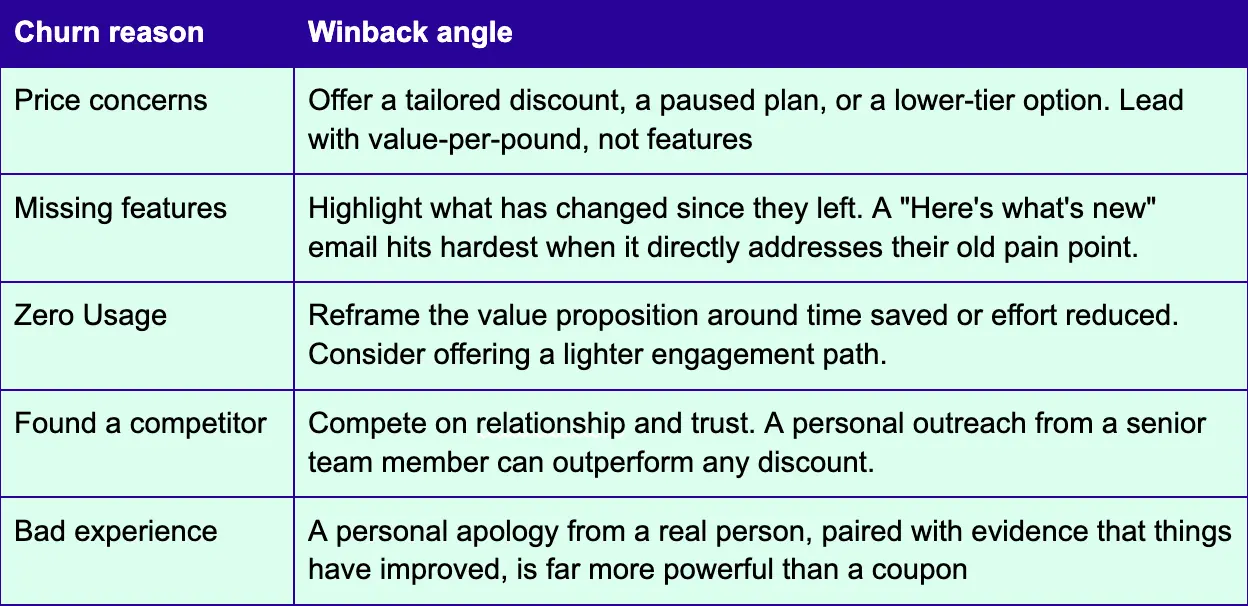
Common subscriber churn reasons & winback angle
Not all churn is equal, and the single biggest mistake businesses make is treating it as though it were. Before the winback strategy is put into action, one needs to understand why the users left, and whether they are worth pursuing. Even when the subscriber does leave, that churn metrics related data become the foundation of every winback message that will be send to them.
Customer winback strategies for subscription businesses
Strategy 1: Segmentation
The cardinal rule of winback is that it only works when it's personal. Begin by segmenting the churned subscribers by lifetime value, tenure, cancellation reason, and time since cancellation. High-LTV subscribers with long tenures warrant a premium approach like direct outreach from the customer success or leadership team. Lower-value subscribers may need a single well-timed incentive email. Treating every cancellation the same is the fastest route to an empty inbox.
Strategy 2: Cancellation flow
The cancellation flow is the most underrated retention tool. Brands that deploy in-app cancellation flows with structured exit questions reduce churn by 15-25% in real time, because they can immediately address the subscriber's specific objection. A well-designed cancel flow can present targeted deflections such as:
- Pause option for the overwhelmed
- Downgrade for the price-sensitive
- One-click fix for the technically frustrated
Strategy 3: Outreach timing
The timing of the first winback message matters enormously. Acting too quickly can come off as desperate while waiting too long can create the risk of subscriber moving on.
Most subscription businesses find the sweet spot is 7-30 days post-cancellation, but this varies significantly by product type, billing cycle, and competitive landscape. Best approach is to map the resubscription data to find when former customers are most likely to return naturally and then intercept them there.
Strategy 4: Multi-touch sequence
Single emails rarely perform well, therefore, a sequence of three to five messages, spaced over time, improves reactivation rates. Each message should build on the previous one, moving from context to value to offer.
Strategy 5: Omnichannel
Email gets most of the attention in winback playbooks, but the brands with the highest reactivation rates don't rely on a single channel. Depending on the product and customer profile, SMS nudges, retargeting ads, in-app notifications, direct mail for high-value segments, and personal outreach from account managers all have a role. The key is coordinating these touchpoints into a coherent experience rather than a scattered series of interruptions.
Strategy 6: Leading with empathy
One of the most effective winback campaigns ever run by a subscription brand didn't offer a discount at all. It simply asked: "What did we get wrong?" That question is genuine, open, non-transactional which is why it generated more replies and more reactivations than months of promotional emails had managed. Former subscribers don't want to feel like an acquisition target. They want to feel understood. When the outreach demonstrates that the company actually listened to why they left, there is an immediate shift in the dynamic.
Strategy 7: Capitalize on one-time returners
When a former subscriber makes a one-time purchase without resubscribing, it is a golden window. Reaching out immediately, within 24 hours, with a message that acknowledges their return and reminds them of the specific benefits they would receive as an active subscriber is the winning move. This moment of cancellation remorse is fleeting and the brands that act on it see some of their highest winback conversion rates.
Measuring winback performance
The effectiveness of winback should be evaluated using metrics tied to long-term outcomes:
- reactivation rate
- time to reactivation
- retention after reactivation
- revenue generated from reactivated subscribers
Tracking these metrics helps distinguish between short-term recovery and sustained value.
Conclusion
Winback is most effective when it is integrated into the lifecycle rather than treated as a one-off campaign. Segmenting churned subscribers based on behavior and intent allows teams to apply targeted interventions and measure their impact over time. This creates a system where reactivation is repeatable rather than dependent on individual campaigns.
AI-powered lifeycle retention platforms like Subsets support this by enabling teams to identify churned users using predictive audiences, test winback strategies across segments, measure how those interventions affect retention after reactivation, and make the winning tests always-on journeys for future subscribers. If you are looking to structure winback as part of your retention system, book a demo with Subsets to see how it works in practice.
Frequently asked questions
What is a customer winback strategy for subscription businesses?
A customer winback strategy is a structured approach that subscription businesses use to re-engage subscribers who have cancelled or become inactive. Unlike retention strategies, which prevent churn before it happens, winback campaigns focus on recovering the relationship after a subscriber has already left. They typically involve personalised outreach across email, SMS, or direct channels, timed offers, and messaging tailored to the specific reason the subscriber churned.
Why is customer winback important for subscription businesses?
Winback matters because churned subscribers are significantly cheaper to recover than new customers are to acquire. A former subscriber already knows the product, understands its value, and made a deliberate decision to subscribe in the first place. That familiarity shortens the conversion cycle and increases post-reactivation retention. As subscriber acquisition costs have risen and conversion rates have declined, winback has become a core growth lever rather than an optional campaign.
What is the difference between customer winback and customer retention?
Customer retention targets subscribers who are still active but at risk of leaving, with the goal of preventing churn before it occurs. Customer winback targets subscribers who have already cancelled, with the goal of reactivating them after the fact. Both are part of lifecycle management, but they require different triggers, messaging, and incentives. Winback outreach begins after cancellation, while retention outreach happens during the active subscription period.
When is the best time to send a winback message after cancellation?
Most subscription businesses find the sweet spot is between 7 and 30 days after cancellation. Acting too quickly can feel desperate, while waiting too long risks the subscriber finding a replacement or simply forgetting the product existed. The ideal timing depends on the product's billing cycle and competitive landscape. The best approach is to analyse existing resubscription data to identify when former customers return naturally, then build automated triggers around those windows.
Should winback campaigns always include a discount?
No. Some of the most effective winback campaigns include no discount at all. A message that simply asks "what did we get wrong?" and genuinely invites feedback has outperformed months of promotional emails for subscription brands. Discounts are appropriate for price-sensitive churners but can feel tone-deaf or even insulting to subscribers who left because of a poor experience or a missing feature. The incentive should match the reason for leaving, and empathy often converts better than a percentage off.
.png)