.svg)

.svg)
The 90-day subscriber retention problem
Retention teams often expect the first quarter of a new initiative to answer a fairly straightforward question: Is this working? The assumption sounds reasonable. New lifecycle journeys have been launched, audiences have been rebuilt, and interventions are reaching subscribers who previously received little or no retention-focused communication. By the end of 90 days, there should be enough evidence to determine whether the strategy is improving outcomes.
What makes retention frustrating is that this expectation collides with how retention programs operate. In many organizations, the first quarter produces very little clarity. Retention looks broadly unchanged, engagement moves in a few places but not others, and the discussion quickly turns toward whether the segmentation was wrong, whether the messaging was ineffective, or whether the retention platform failed to deliver on its promise.
Consider the comparison to product development. No product team would expect to redesign a feature, launch it to customers, collect no experimental data, compare aggregate company metrics three months later, and confidently declare success or failure. Yet this is remarkably close to how retention initiatives are often evaluated.
The retention measurement challenge
The first challenge appears in measurement. Many retention programs launch without a meaningful comparison group. A campaign is delivered, subscribers receive a new experience, and the team waits to see what happens. Three months later, retention is reviewed against historical performance.
Historical performance seldom answers the question the team is trying to ask. What matters is whether subscribers who received the intervention behaved differently from comparable subscribers who did not. Without that comparison, a retention initiative can generate genuine value while still appearing inconclusive because there is no reliable way to isolate its impact.
Reliable measurement also requires the right level of confidence. A test may show early movement in engagement or retention. However, teams still need to understand whether the result is strong enough to act on, whether the audience size is large enough, and whether the lift holds beyond the first response window. Without that discipline, teams can overreact to weak signals or ignore promising interventions because the reporting does not make the strength of the result clear.
Even when measurement is handled correctly, the signal is often obscured by the way organizations report retention. Subscriber behavior is usually compressed into a handful of aggregate metrics that blend the following segments:
- First-time subscribers
- Long-tenured subscribers
- Annual plans
- Monthly plans
- Discounted acquisitions
- Organic acquisitions
- Highly engaged readers
- Dormant users
Improvements within one audience are easily offset by deterioration in another, producing a top-line number that suggests little has changed.
An apples to oranges comparison cannot yield a report that can scale retention.
A success story for comparing the right segments is a multi-platform media client. The company launched 25+ concurrent, individual lifecycle initiatives that delivered:
- +7.8% retention lift from new subscribers
- +163% increase in app engagement among high-risk subscribers
- +5.6% retention improvement from disengagement automation
- +5.9% retention lift from upgrade campaigns
- +5.1% retention improvement from low-engagement automation
Such gains are meaningful, but they become difficult to see when viewed only through aggregate retention reporting.
For subscription businesses to succeed in 2026, measurement needs to be built around statistically sound experiments with control groups, retention-weighted metrics, and long-term business outcomes rather than campaign response alone.
The infrastructure gap
The operational side of retention creates a second set of problems. Most teams struggle to execute enough experiments to discover which ideas work.
Subscriber behavior is scattered across content systems, analytics platforms, billing tools, marketing platforms, and data warehouses. Building a retention audience often requires pulling information from multiple places with the help of engineering teams, before anyone can begin testing a hypothesis. The effort required to assemble an experiment becomes so large that experimentation itself becomes scarce.
The same friction appears when teams try to run experiments through their existing channels. A retention idea may depend on a CRM audience, billing status, content engagement, subscription tenure, and messaging logic all working together. When those systems are disconnected, even simple tests require manual coordination, data requests, and technical support. This slows commercial teams down and makes every new hypothesis feel heavier than it should.
This has consequences that are easy to underestimate. Retention improves through accumulated learning. A team running three experiments in a quarter is operating under very different conditions from a team running twenty or more concurrent lifecycle tests. Learning compounds in retention much the same way it does in product development. Organizations that learn faster tend to improve faster because they create more opportunities to discover which subscriber behaviors matter, which interventions influence those behaviors, and which deserve further investment.
This is why retention teams increasingly need retention automation across CRM, CDP, and messaging tools, rather than another disconnected campaign workflow. The goal is to reduce the operational distance between identifying an opportunity, launching an experiment, measuring the result, and applying the learning.
The ever-changing subscriber behavior
Subscriber behavior introduces another complication to the equation. Most audience definitions are created at a specific point in time, even though subscribers are constantly moving through the lifecycle.
A subscriber identified as high-risk today may become highly engaged next week after discovering a new content category. Another subscriber may gradually drift toward cancellation despite appearing healthy when the audience was originally built. Static segmentation creates a lag between subscriber behavior and retention activity. The longer that lag becomes, the less relevant the audience becomes.
The impact of acting on these ever-changing signals can be substantial. A streaming media business, with more than 10 million subscribers, targeted lifecycle interventions that produced a 10.1% retention lift among high-risk trial users and increased streaming hours by 296% among high-risk new subscribers. Those opportunities existed because subscriber behavior was identified and acted on while it was changing rather than after the outcome had already occurred.
Retention teams need a way to identify meaningful behavioral changes across the lifecycle, understand why a subscriber belongs in a given audience, and act before the opportunity disappears. This is where having predictive audiences in your retention platform becomes invaluable.
No way to scale successful experiments
Perhaps the most expensive problem appears after an experiment succeeds. Retention teams regularly discover interventions that improve activation, engagement, renewal, or reactivation. The findings are documented, shared internally, and presented to stakeholders. What happens next is surprisingly inconsistent. In many organizations, the successful intervention remains an isolated success rather than becoming part of the ongoing subscriber experience.
Future cohorts continue to move through the lifecycle without benefiting from what the previous experiment revealed. The organization accumulates insight without accumulating impact.
This creates a cycle where teams repeatedly prove the same ideas instead of building on previous discoveries. A successful onboarding sequence improves activation for one audience. A re-engagement campaign improves retention for another. A personalized renewal journey performs well against a control group. Yet each remains a standalone initiative rather than becoming part of a larger retention system.
The highest-performing retention organizations treat successful experiments as infrastructure. Once an intervention proves its value, it becomes an always-on journey in the lifecycle, allowing future subscribers to benefit automatically from what previous cohorts taught the business. That also means the journey cannot simply be switched on and forgotten. Performance needs to be monitored over time, audiences need to stay current, and subscribers need sensible prioritization so they are not pushed into too many overlapping interventions at once.
Retention improves when learning compounds
Viewed individually, each of these issues seems manageable. Together, they explain why so many retention programs struggle to demonstrate meaningful progress within their first ninety days.
The systems surrounding the strategy often make learning slow, experimentation expensive, measurement uncertain, and operationalization inconsistent. Subscriber, behavioral, billing, and engagement data remain fragmented. Audiences are built manually. Experiments depend on operational workarounds. Measurement relies too heavily on campaign metrics or aggregate retention. Successful tests remain trapped in reports and presentations.
The organizations that move beyond the ninety-day wall usually solve these problems at the system level. Their data is connected. Their audiences update continuously as subscriber behavior changes. Their commercial teams can launch experiments without depending on engineering resources for every new hypothesis. Their measurement is built around controls and long-term business outcomes. Their successful experiments become permanent parts of the lifecycle.
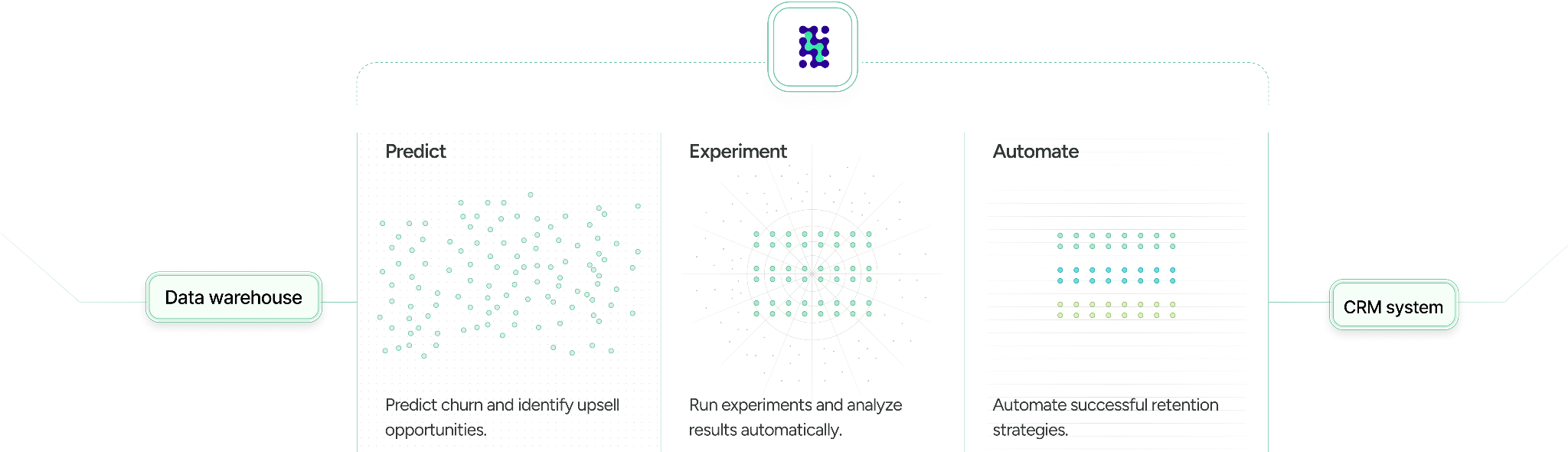
That is also what Subsets was built to support. By combining unified lifecycle data, predictive audiences, experimentation, measurement, and always-on automation in a single platform, Subsets helps retention teams identify the right audiences, understand the behavioral drivers behind them, test interventions through existing channels, measure results with control groups, and turn winning experiments into journeys that continue to improve subscriber outcomes over time. Book a demo to see how Subsets helps teams move beyond the 90-day retention wall.
Frequently asked questions
Why do subscriber retention initiatives often show no clear results in the first 90 days?
Most retention programs launch without a control group, so there's no way to isolate the intervention's impact. Results get measured against historical performance and reported through aggregate metrics that blend very different subscriber segments. Improvements in one audience get cancelled out by declines in another, producing a flat top-line number even when the strategy is working. The first quarter usually reflects measurement and infrastructure gaps, not the strategy itself.
How should subscriber retention be measured correctly?
Retention should be measured with statistically sound experiments that compare subscribers who received an intervention against comparable subscribers who did not. That means using control groups rather than historical baselines, confirming the audience size is large enough and the lift holds beyond the first response window, and tracking retention-weighted metrics and long-term business outcomes instead of campaign response alone.
Why do aggregate retention metrics hide the impact of retention campaigns?
Aggregate reporting compresses very different segments. Gains in one segment are offset by losses in another, so meaningful improvements disappear at the top line. Measuring each segment separately is what makes real lift visible.
Why does static audience segmentation reduce retention performance?
Subscribers move through the lifecycle constantly, but most audiences are defined at a single point in time. A high-risk subscriber today may become highly engaged next week, while a healthy-looking subscriber may drift toward cancellation. Static segments create a growing lag between subscriber behavior and retention activity, so the audience becomes less relevant over time. Predictive audiences that update continuously let teams act on behavioral changes while they're happening rather than after the outcome is locked in.
How do retention teams scale a successful experiment?
The highest-performing teams treat winning experiments as infrastructure rather than one-off wins. Once an intervention proves its value against a control group, it becomes an always-on journey in the lifecycle so future subscribers benefit automatically. That requires ongoing monitoring, audiences that stay current, and sensible prioritization so subscribers aren't pushed into too many overlapping interventions. Without this, organizations keep accumulating insight without accumulating impact.
.png)